4-Week At-Home Workout Plan (Minimal Gear + Daily Stretches)
Fit at Home: A 4-Week Minimal-Equipment Workout Plan With Daily Stretches
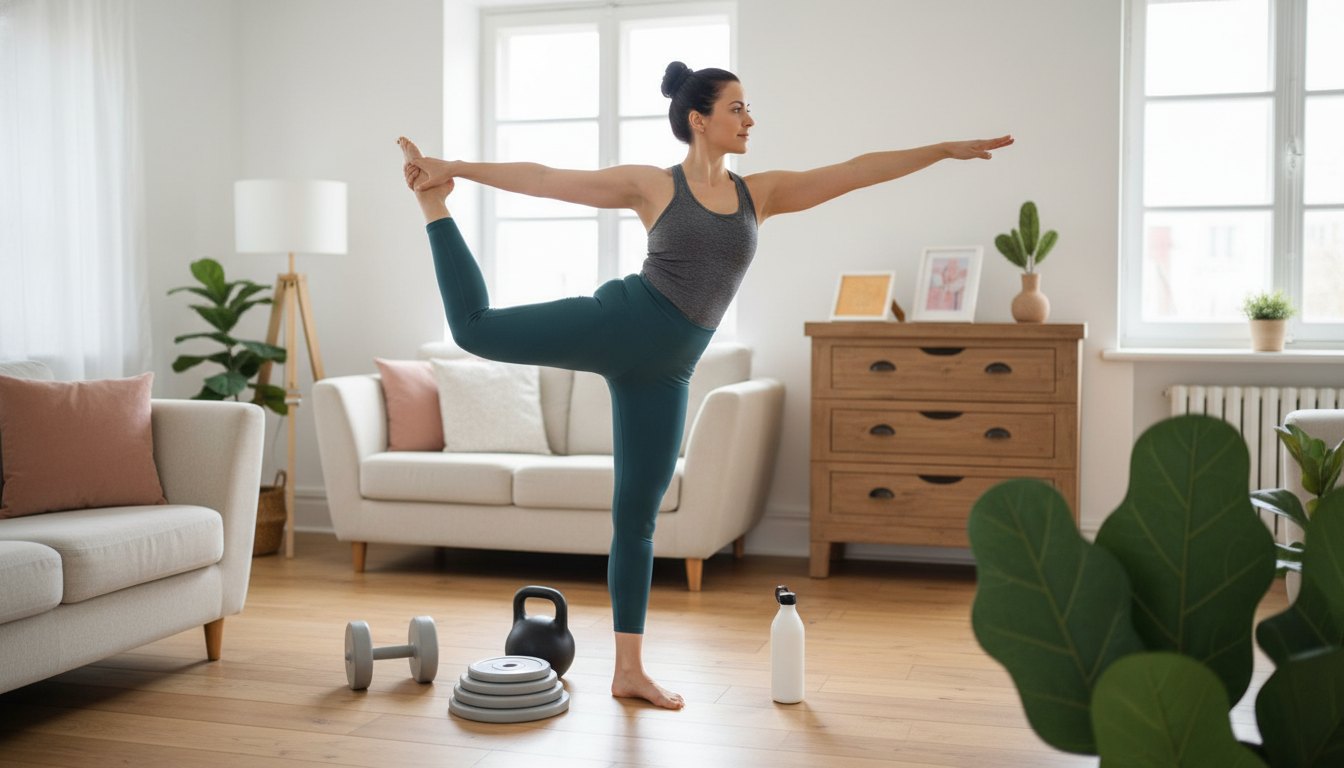
A consistent routine is easier to follow when each day is already planned. This 4-week home fitness PDF is built around short, structured daily workouts plus stretches, using minimal equipment so it fits small spaces, busy schedules, and a wide range of fitness levels. The goal isn’t to “go all out” once—it’s to build repeatable momentum you can carry beyond four weeks, with smart progressions that keep joints happy and results moving.
What the 4-week plan is designed to do
This plan is built around a simple weekly rhythm: workout, stretch, recover, repeat. By removing daily guesswork, it becomes easier to show up consistently—even on days when motivation is low.
- Build a repeatable weekly rhythm that removes guesswork: workout, stretch, recover, repeat.
- Develop full-body strength and basic conditioning using bodyweight and a few optional items.
- Support better movement quality with daily stretching and mobility work.
- Encourage progressive overload through small, realistic increases (reps, tempo, sets, rest control).
General public health guidance supports combining strengthening work with regular activity across the week. If you like to cross-check baseline recommendations, see the CDC’s Physical Activity Basics and the ACSM exercise guidelines.
What’s included in the PDF eBook
The PDF is structured to feel like a daily prompt you can follow without overthinking. It’s especially helpful for anyone who tends to bounce between random videos or unstructured workouts.
- Daily workout prompts that can be followed without designing a program from scratch.
- Warm-up guidance to prepare joints and muscles before harder sets.
- Cool-down stretches to help restore range of motion and reduce stiffness after training.
- A simple structure that can be repeated for four weeks with planned progression.
If you want a ready-to-go version, the product page for Fit at Home: 4-Week Workout Plan (PDF) includes the full downloadable plan and daily structure.
Minimal equipment setup (and easy substitutions)
The plan works bodyweight-only, but a few add-ons can make progress smoother over time—especially for pulling movements and load progression.
- Primary option: bodyweight-only (squats, hinges, pushes, pulls using household anchors, core work).
- Helpful add-ons: a resistance band, a chair/bench, a yoga mat, and a light-to-moderate dumbbell or kettlebell (optional).
- Substitutions: backpack with books for load; towel for grip/assistance; stairs for step-ups; sturdy table edge for supported rows (only if stable).
- Space needs: a clear area roughly the size of a yoga mat plus arm’s reach.
Quick equipment substitution ideas
| Movement need | Gym tool | At-home substitute |
|---|---|---|
| Added weight | Dumbbell/kettlebell | Backpack with books or water bottles |
| Pulling resistance | Cable/bands | Towel row against a sturdy anchor or band in a door anchor |
| Bench support | Bench | Chair or couch edge (check stability) |
| Soft surface | Gym mat | Yoga mat or folded towel |
How a typical day is structured
Each day is short enough to fit into real life, but structured enough to create measurable progress. The order matters: warm-up first, focused work second, then downshift with stretching.
- Warm-up (5–8 minutes): gentle pulse raiser plus joint circles and activation (hips, shoulders, core).
- Main workout (15–30 minutes): a focused set of movements (strength, conditioning, or mixed).
- Cool-down stretches (5–10 minutes): slower breathing, targeted holds for hips, hamstrings, chest, back, and calves.
- Optional finisher (2–5 minutes): short, low-impact conditioning or core if energy and recovery allow.
Example weekly rhythm (repeat and progress across 4 weeks)
Sample week layout (minimal equipment)
| Day | Focus | What it feels like | Stretch emphasis |
|---|---|---|---|
| Day 1 | Full-body strength | Moderate effort, controlled reps | Hips + chest opener |
| Day 2 | Low-impact conditioning + core | Breathable pace, steady work | Calves + hamstrings |
| Day 3 | Lower-body + posterior chain | Legs/glutes engaged | Hip flexors + glutes |
| Day 4 | Mobility/recovery | Easy, restoring | Spine + shoulders |
| Day 5 | Upper-body + core | Push/pull focus | Thoracic rotation + lats |
| Day 6 | Full-body circuit | Short bursts, manageable intensity | Full-body cooldown |
| Day 7 | Rest or gentle walk | Very easy | Light stretching as needed |
Stretches that pair well with at-home training
Simple stretch menu (choose 3–5 after workouts)
| Area | Stretch | Time |
|---|---|---|
| Hips | Half-kneeling hip flexor stretch | 30–45 seconds/side |
| Hamstrings | Supine hamstring stretch (strap/towel) | 30–45 seconds/side |
| Calves | Wall calf stretch | 30–45 seconds/side |
| Chest | Doorway pec stretch | 20–30 seconds/side |
| Back | Child’s pose with side reach | 30–60 seconds |
How to progress safely over 4 weeks
Modifications for beginners and upgrades for advanced users
Practical tips to make the plan stick
If you enjoy checklists and simple routines, a printable planning tool can also help build consistency in other areas of life. The Homework Help Made Easy Toolkit for Parents – Printable Guide is a separate printable resource focused on habit-building structure for study time.
Product details and how to use it
Fit at Home plan snapshot
| Item | Detail |
|---|---|
| Program length | 4 weeks |
| Equipment | Minimal (bodyweight + optional band/chair/light load) |
| Includes | Daily workouts + daily stretches |
| Price | $21.99 USD |
FAQ
How long are the daily workouts?
Most days take about 20–40 minutes total including warm-up and stretches. The exact time depends on rest periods and whether you add the optional finisher.
Is the plan suitable for beginners with no equipment?
Yes—beginners can start with bodyweight-only options like incline push-ups and chair-supported squats, using fewer rounds and longer rest. Focus on clean reps and steady pacing, then build gradually week to week.
Can the PDF be printed and used as a checklist?
Yes—print on standard letter paper and keep it in a binder or clip it to a clipboard for quick daily check-offs. Mark completed days and track a couple key numbers (like reps or rounds) to see progress over the four weeks.










Leave a comment