Validate Your Next Business Idea: Trends, Gaps, MVP Tests

Find Your Next Big Business Idea: A Practical Toolkit for Trendspotting, Market Gaps, Validation, and MVP Tests
A strong business idea rarely comes from a single lightning-bolt moment. It’s more often the result of a repeatable workflow: notice demand shifts early, translate them into underserved problems, validate willingness to pay, and run a simple MVP test before investing heavily. When the process is consistent, the odds of building something people actually buy go up—and the odds of burning months on a “cool concept” go down. For more guidance, see Opportunities and challenges of artificial intelligence technologies ….
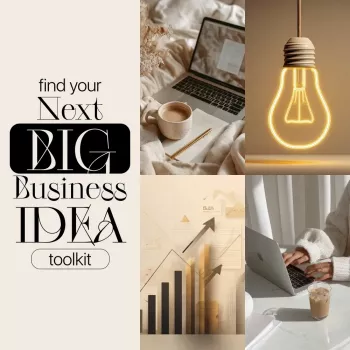
If you want a structured system (with templates and a scorecard) to decide what to build next, the Find Your Next Big Business Idea Toolkit (Ebook) is designed to help you capture signals, narrow to the best opportunities, and choose a direction based on evidence. For further reading, see How to research your business idea | Origin Bank.
What makes a business idea “big” (and what usually breaks it)
“Big” ideas usually share a few unglamorous traits: the problem is painful, the buyer is clear, and there’s a straightforward way to reach them. Novelty helps, but it’s rarely the foundation.
- Problem strength beats novelty: Recurring pain, clear urgency, and a defined buyer matter more than originality.
- Distribution is part of the idea: If reaching customers is expensive or unclear, the “idea” is incomplete.
- False signals to avoid: Vanity metrics, loud social buzz without purchase intent, and “my friends say they’d buy” feedback.
- A practical definition of traction: Evidence like pre-orders, deposits, qualified waitlists, pilots, or letters of intent—not just opinions.
A useful mental shift: the goal isn’t to prove an idea is “great.” The goal is to quickly discover whether real buyers will commit time, money, or reputation to it.
Trendspotting that leads to real opportunities
Trendspotting works when it focuses on leading indicators—signals that appear before a market gets crowded. Three reliable categories: changes in rules, changes in platforms, and changes in costs.
- Track leading indicators: New regulations, platform shifts, cost changes (labor, ads, logistics), and emerging workflows in specific industries.
- Use a three-lens scan: (1) consumer habit shifts, (2) business operational changes, (3) technology enabling faster/cheaper delivery.
- Look for second-order opportunities: tooling, compliance, integrations, training, migrations, and “how-to” systems that appear after the trend starts.
- Create a weekly capture habit: log a signal, add a source link, write who/what/why, and note a likely buyer persona.
Helpful resources for spotting demand shifts include Google Trends for search movement and the Y Combinator Library for market-testing patterns.
Trend-to-Opportunity Capture Template
| Signal | Who feels it first? | Likely pain | Possible offer | Fast validation test |
|---|---|---|---|---|
| New policy/regulation | Operators/compliance leads | Fear of penalties, complexity | Compliance-as-a-service, templates, audits | Landing page + paid search around the policy keyword |
| Platform algorithm change | Creators/brands | Traffic drop, unpredictability | Analytics, content ops, diversification playbook | 3 customer interviews + waitlist for a dashboard/tool |
| Cost spike (ads/shipping/labor) | SMBs with thin margins | Profit squeeze, churn risk | Cost-reduction service, automation, alternative channel kit | Offer a fixed-price pilot to 5 businesses |
Finding market gaps without guessing
Market gaps usually aren’t empty spaces. They’re often areas where people are already spending time and money—but the current options are frustrating, incomplete, or misaligned with how buyers work.
- Map the job-to-be-done: What are people trying to accomplish, and what does “good enough” mean in their context?
- Spot gaps in three places: underserved segments, weak alternatives (workarounds/spreadsheets), and high switching costs that trap customers.
- Analyze competitor omissions: missing integrations, unclear onboarding, pricing mismatch, or lack of vertical specialization.
- Define a crisp wedge: a narrow, painful, frequent use case with reachable buyers and room to expand later.
Validation that reduces risk before building
MVP tests that give a clear go/no-go
Practical MVP Tests and What They Prove
| Test type | What it proves | Best for | Key metric |
|---|---|---|---|
| Landing page + waitlist | Messaging and initial demand | Early-stage B2C/B2B | Visit-to-signup rate |
| Paid pilot (fixed scope) | Willingness to pay + delivery feasibility | B2B services/SaaS | Close rate + margin |
| Concierge MVP | Outcome value before automation | Complex workflows | Time-to-value + repeat usage |
| Pre-order / deposit | True purchase intent | Products/info products | Deposit conversion rate |
Using an idea scorecard to choose what to build next
What’s included in the Find Your Next Big Business Idea Toolkit (Ebook) and how to use it
The Find Your Next Big Business Idea Toolkit (Ebook) brings the workflow into a set of practical templates you can reuse for every new concept:
If you’re also building better learning routines at home (often a real-world “operations problem” for busy families), the Homework Help Made Easy Toolkit for Parents is another structured, template-driven resource that focuses on repeatable systems and measurable progress.
FAQ
How long does it take to validate a business idea before building?
Most ideas can be validated in 1–4 weeks if you can reach real buyers quickly. Set short test cycles (7–14 days), define success metrics in advance, and stop early if you can’t clear minimum thresholds for reachability and willingness to pay.
What’s the difference between trendspotting and chasing hype?
Trendspotting focuses on leading indicators (regulations, platform shifts, cost changes) and measurable buyer behavior, while hype is mostly viral attention without proof of budget or urgency. Second-order opportunities—like compliance templates, integrations, training, or migration help—often convert better than the headline trend itself.
Which MVP test works best for a service idea versus a software idea?
Service ideas usually validate fastest with a concierge MVP or paid pilot because it proves outcomes and willingness to pay immediately. Software ideas often start with a landing page plus demo/prototype to test demand and messaging before investing in a full build.










Leave a comment