Memory Boost Worksheets: Printable & Digital Recall Drills
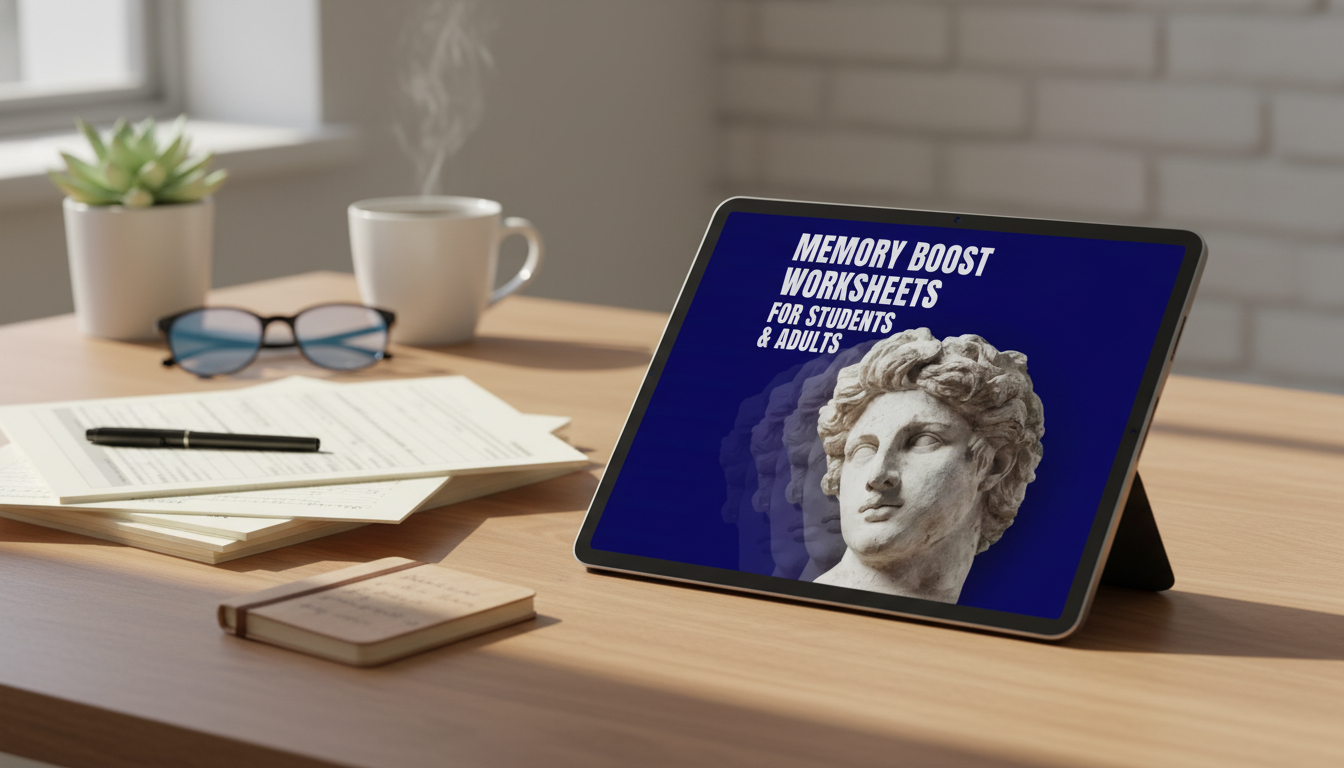
Memory Boost Worksheets for Students & Adults: Printable Exercises and Digital Tools for Better Recall
Memory improves fastest when practice is structured, repeatable, and tied to real tasks like studying, work training, and daily routines. A printable-and-digital worksheet system makes it easier to build consistent habits, track progress, and apply proven techniques—retrieval practice, chunking, spacing, and visual encoding—without guesswork. Instead of relying on “more time” or “more highlighting,” these pages turn memory training into a simple routine you can start in minutes.
Who These Worksheets Help Most
- Students: Strengthen study recall for vocabulary, formulas, dates, and reading comprehension using short daily drills.
- Adults: Sharpen everyday memory (names, tasks, appointments) and reduce “tip-of-the-tongue” moments with focused practice.
- Test-takers: Build confidence with timed recall, cue-based prompts, and error logs that turn mistakes into targets.
- Lifelong learners: Keep skills active with low-friction, repeatable brain-training routines.
- Busy schedules: Printable pages for offline focus plus digital files for quick reuse and note-taking.
What’s Inside a Strong Memory Training Pack
The most useful worksheet packs do more than provide “brain games.” They guide how to encode information so it sticks, then force retrieval so you can actually use it under pressure (during a quiz, meeting, or conversation).
- Guided technique pages: Step-by-step prompts for encoding (making information memorable) and retrieval (pulling it back on demand).
- Practice worksheets: Short sets that train attention, working memory, and long-term recall without being overwhelming.
- Study & recall tools: Templates for summaries, flash prompts, self-quizzes, and recall checks that don’t require extra apps.
- Progress tracking: Simple logs to spot what sticks, what fades, and what needs spaced review.
- Printable + digital flexibility: Print for distraction-free sessions; reuse digitally for ongoing practice and multiple subjects.
How to Use the Worksheets in a 10–15 Minute Routine
A short routine works best when it’s consistent. The goal is not to “study longer,” but to practice remembering more efficiently.
- Step 1 — Choose one target: A chapter, a list, a process, or a set of facts that matters this week.
- Step 2 — Encode with structure: Chunk information into 3–7 items, add a visual cue, and write a one-sentence meaning statement.
- Step 3 — Retrieve without looking: Do a blank-page recall, then check and correct using an error log.
- Step 4 — Space it out: Repeat recall after a short gap (later today), then again tomorrow, then in 3–7 days.
- Step 5 — Mix topics: Alternate between two subjects to strengthen discrimination and reduce false familiarity.
- Optional — Time-box: Quick timed rounds build automaticity and reduce test-day freezing.
Sample Weekly Plan (Printable or Digital)
| Day | Focus | Worksheet Actions | Time |
|---|---|---|---|
| Mon | New material | Chunk + visual cue + first recall check | 10–15 min |
| Tue | First review | Blank-page recall + error log | 10 min |
| Wed | Interleaving | Mix Topic A/Topic B recall prompts | 10–15 min |
| Thu | Second review | Spaced recall + quick self-quiz | 10 min |
| Fri | Application | Teach-back summary + real-world example | 10–15 min |
| Weekend | Light maintenance | One timed round + revisit errors | 8–12 min |
Core Memory Techniques the Pages Should Reinforce
Effective worksheets bake learning science into the prompts, so better memory becomes the default outcome of the routine. Research supports practice testing (retrieval) as a high-impact strategy, often outperforming passive study methods (see Science on retrieval practice). Spacing and interleaving also show strong benefits for durable learning (see The Learning Scientists resources), and spaced repetition is a well-established concept in psychology (see APA Dictionary: spaced repetition).
- Retrieval practice: Repeatedly pulling information from memory is more effective than rereading notes.
- Spaced repetition: Increasing intervals between reviews strengthens long-term retention.
- Elaboration: Adding meaning, examples, and “why it matters” anchors facts to existing knowledge.
- Dual coding: Pairing words with simple visuals improves recall for many learners.
- Chunking and organization: Grouping items reduces working-memory load and improves accuracy.
- Metacognition checks: Confidence ratings + error tracking reduce overconfidence and target weak spots.
Printable vs Digital: Choosing the Right Format for Your Habits
- Printable strengths: Fewer distractions, easier for quick drills, great for binders and study stations.
- Digital strengths: Duplicate pages endlessly, type answers, annotate, and organize by folder/subject.
- Hybrid approach: Print core drill sheets; keep logs and review schedules digitally to stay consistent.
- Best practice: Keep worksheets visible and easy to start—memory improves with frequency, not marathon sessions.
Memory Boost Worksheets for Students & Adults (Printable Digital Download)
If the goal is better recall without reinventing a study system each week, a structured pack can keep practice simple and repeatable. Memory Boost Worksheets for Students & Adults | Printable Digital Download is designed to support both academic study and everyday recall with guided technique pages, short drills, and recall-focused templates.
Helpful Add-On for Study Routines
Memory practice sticks best when it has a dependable time and place in the week. For families building consistency—especially with younger learners—a routine toolkit can make it easier to keep sessions short and regular. Homework Help Made Easy Toolkit for Parents – Printable Guide for Creating Study Habits supports scheduling, independence, and parent-guided routines that pair well with brief recall drills.
FAQ
How often should memory worksheets be used to see results?
Aim for 10–15 minutes per session, about 4–6 days per week. Results come from spaced review and consistent short sessions, not occasional long cram sessions.
Are these worksheets better than rereading notes or highlighting?
Active recall and self-testing usually work better than passive review because they force the brain to retrieve information. Notes and highlighting can still help, but they work best as a quick reference after you attempt recall.
Can adults use the same memory exercises as students?
Yes—adults can use the same mechanisms (chunking, spacing, elaboration, and retrieval practice) while swapping the content for names, tasks, procedures, or job-related knowledge.









Leave a comment