More Time, Less Stress: Pomodoro, Priorities, Time Blocking
More Time, Less Stress Starts with a Better System (Not a Longer Day)
Busy days can feel like a constant race—tasks pile up, priorities blur, and stress spikes when everything seems urgent. The good news: “more time” usually isn’t found by working faster. It’s found by working with fewer decisions, fewer interruptions, and clearer boundaries. This practical mini-course and companion ebook centers on a simple, repeatable system built around three proven tools: Pomodoro focus sessions, the Eisenhower Matrix for prioritizing, and time blocking to protect what matters most.
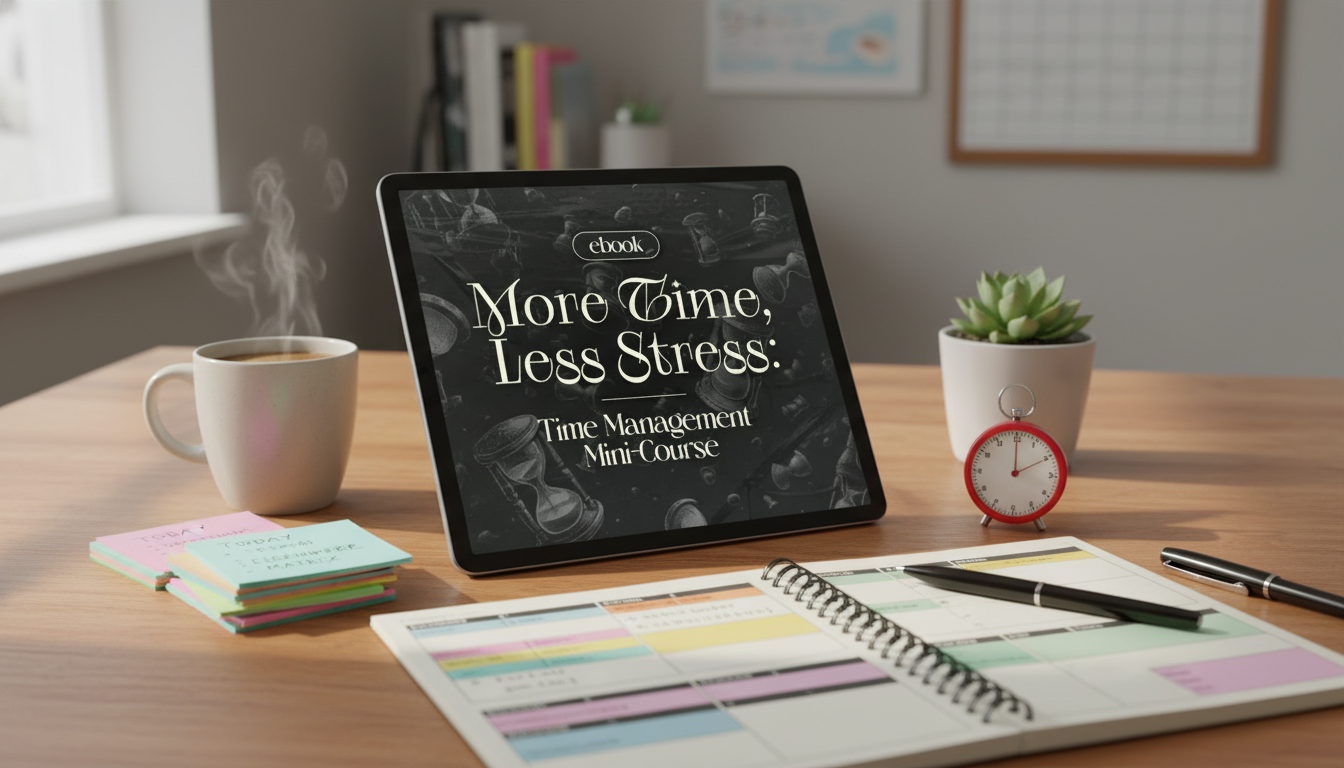
If you want a guided, ready-to-follow setup, see the More Time, Less Stress: Time Management Mini-Course – Productivity Ebook with Pomodoro, Eisenhower Matrix & Time Blocking Strategies.
What “more time” really means (and why it feels so hard to find)
Time pressure often comes from three sneaky sources: unclear priorities, frequent context switching, and underestimating how long tasks take. When everything looks equally important, you spend the day deciding (and re-deciding) what to do next—while your attention gets pulled into messages, requests, and “quick” tasks that multiply.
A workable system reduces decision fatigue by creating defaults: when to focus, what to do next, and when to stop. That last part matters. Stress drops fastest when your day has clear boundaries—start, finish, breaks—and a short list of “must-do” outcomes that define success even if the day isn’t perfect.
How the mini-course is structured: three tools that reinforce each other
These tools work best as a sequence. First decide what matters, then protect time for it, then execute in focused sprints. That order keeps your calendar realistic and your focus sessions meaningful.
| Tool | Best for | What it produces | Common mistake to avoid |
|---|---|---|---|
| Eisenhower Matrix | Deciding what deserves attention | A short list of important tasks | Treating everything as urgent |
| Time Blocking | Protecting time for the important tasks | A realistic daily plan on a calendar | Over-scheduling with no buffer |
| Pomodoro | Executing with focus and momentum | Completed work in measurable sprints | Skipping breaks and losing quality |
For background on the original method, the Pomodoro Technique official site is a solid reference. For broader research-backed guidance on productivity and time management, Harvard Business Review’s time management topic is a helpful starting point.
Pomodoro that actually works on real-life schedules
Pomodoro works best when it’s treated like a training plan for attention—not a strict rule you “fail” the moment someone calls. Start with the classic rhythm (25 minutes of focus + 5 minutes break), and only adjust after a week of tracking energy and results. Some people do better with 40/10; others need 20/5. The key is consistency long enough to learn what’s real.
Before the timer starts, define the task as one clear outcome per sprint. “Draft outline” is a Pomodoro-sized target; “work on report” is vague and invites wandering. During breaks, reset your body and attention—stand up, hydrate, quick breathing, or a short walk—while avoiding a second demanding task that hijacks your recovery.
Finally, protect your focus sessions by batching shallow work (email, messages, admin) into a dedicated block. That way, your deep work isn’t constantly fragmented by “just checking one thing.”
Prioritize with the Eisenhower Matrix: stop rewarding urgency
The Eisenhower Matrix keeps your to-do list honest by separating urgency from importance. Instead of letting the loudest task win, you choose intentionally—and you notice patterns that create recurring fire drills.
For historical context on the concept often attributed to Eisenhower, the Eisenhower Presidential Library is an authoritative reference point.
Time blocking: turn intentions into a day you can actually follow
| Time | Block | Method | Notes |
|---|---|---|---|
| 08:30–09:00 | Plan + prioritize | Eisenhower Matrix | Pick 1–3 key outcomes; confirm calendar realities |
| 09:00–10:30 | Deep work block | Pomodoro (3 rounds) | Single project; notifications off |
| 10:30–11:00 | Admin buffer | Time cap | Quick replies, scheduling, small tasks only |
| 11:00–12:00 | Meetings/collab | Agenda-first | Keep decisions and next steps explicit |
| 13:00–14:00 | Project work | Pomodoro (2 rounds) | Continue or start second priority |
| 14:00–14:30 | Catch-up buffer | Flexible | Overflow, calls, unexpected tasks |
| 16:30–16:45 | Shutdown routine | Review + capture | Log wins, move tasks, set first task tomorrow |
Common friction points and quick fixes
Who benefits most from this mini-course and ebook
If your household includes students, pair your personal time plan with a simple study structure like the Homework Help Made Easy Toolkit for Parents – Printable Guide for Creating Study Habits, Homework Strategies & Independent Learning.
Getting started in 30 minutes: a simple setup
FAQ
How long does it take to see results from Pomodoro, the Eisenhower Matrix, and time blocking?
Most people notice clearer priorities and better follow-through within 1–2 weeks, especially if they track what was planned versus what got completed. Consistency matters more than perfect settings; make small adjustments after you have real data.
What if every task feels urgent?
Separate true deadlines and real consequences from pressure and noise, then time-cap or delegate the “urgent but not important” work. Protect at least one important-not-urgent block daily so long-term priorities don’t disappear.
Is time blocking too rigid for unpredictable days?
Time blocking can be flexible: use movable blocks, add buffers, and anchor the day with one key outcome you protect whenever possible. On chaos days, switch to a minimum viable plan and slide the remaining blocks instead of scrapping the whole schedule.











Leave a comment