A 9-row brush is built for controlled detangling and styling—so hair can be smoothed, shaped, and defined without turning wash day into a tug-of-war. Used with the right amount of “slip” (conditioner, detangler, or leave-in), it can help minimize snagging, support cleaner curl clumps, and leave straight or wavy hair looking more polished. The key is technique: small sections, steady tension, and brushing while hair is properly wet and product-coated.
Below is a practical guide to what makes a 9-row detangling brush different, how to use it across hair types, and how to keep it working well over time.
What a 9-row brush does differently
- Row layout supports controlled tension: Multiple rows help distribute tension more evenly than many wide paddle brushes, which can make detangling feel more predictable and less “grabby.”
- Detangle and style with the same tool: Depending on your angle and product choice, you can use a 9-row brush to smooth straight/wavy hair or to encourage curl clumps on curly textures.
- Best for section-by-section routines: It shines when consistency matters more than speed—especially if you prefer to clip hair up and work methodically.
- Pairs best with slip: Conditioner, detangling spray, or leave-in helps bristles glide so you’re not relying on force.
For general hair-care best practices—especially around gentle handling and minimizing damage—resources from the American Academy of Dermatology Association can be a helpful reference point.
Best uses by hair type
- Straight hair: Use after towel-drying to align strands and smooth the surface. If your roots tangle easily, a wide-tooth comb pass near the scalp can help before brushing lengths.
- Wavy hair: Brush in sections to encourage uniform wave groups, then lightly scrunch to bring back texture and avoid “brushed-out” waves.
- Curly hair: Brush when hair is soaking wet and loaded with product to form defined curl clumps. Keep passes minimal—one thorough pass per section is often enough.
- Coily/tight textures: Use only with ample slip and smaller sections. Many routines go best with finger detangling or a wide-tooth comb first, then a brush pass to refine and define.
Quick routine guide
| Hair type |
Best time to brush |
Product to pair |
Finishing step |
| Straight |
Damp after washing |
Light conditioner/leave-in |
Smooth down, then air-dry or blow-dry |
| Wavy |
Wet or very damp |
Leave-in + light gel |
Scrunch to set waves |
| Curly |
Soaking wet |
Leave-in + curl cream/gel |
Scrunch; diffuse or air-dry |
| Coily |
Wet with conditioner |
Conditioner or detangler |
Twist/braid or scrunch for definition |
How to detangle with less breakage
- Start wet and add slip first: Before the brush touches your hair, apply conditioner or a detangling product and distribute it with your hands. The goal is glide, not grit.
- Work in small sections: Clip hair into 4–8 sections (more if hair is thick or very dense). Smaller sections reduce the temptation to keep re-brushing the same snags.
- Begin at the ends: Detangle from ends upward toward the roots. This gradually releases knots instead of pushing them into tighter tangles.
- Use steady tension—not force: If you feel resistance, pause. Add more product, use fingers to loosen the spot, then continue. Pulling harder is the fast track to breakage.
- Limit repetition: Once a section is detangled, move on. Repeated brushing on the same area can rough up the cuticle and increase frizz later.
If hair breakage is a recurring issue, guidance from the Cleveland Clinic offers practical habits that pair well with gentle detangling (like reducing friction and avoiding overly aggressive handling).
Styling techniques that change the result
- Smoothing for a sleek finish: Brush downward with consistent tension, keeping the brush close to the scalp at the start of each pass for even alignment. For extra polish, follow the brush path with your palm to “press” the hair into place.
- Curl definition: On very wet, product-coated hair, brush through a section once with control. Then lightly shake the section or scrunch upward to encourage the curl to spring back into shape.
- Volume control: If your crown flattens easily, focus brushing on mid-lengths and ends more than the roots. You can also set root volume with clips while hair dries.
- Frizz control: Avoid brushing once hair begins to dry. Set the pattern while hair is wet, then go hands-off until fully dry to reduce frizz and preserve definition.
Care, cleaning, and when to replace
Product spotlight: 9-Row Detangling & Styling Hair Brush
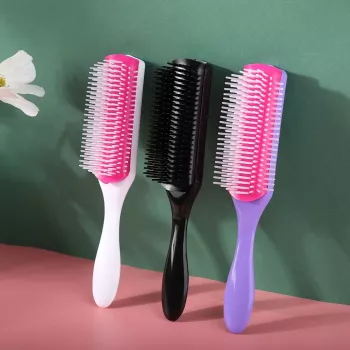
If you want one tool that supports both detangling and styling across multiple textures, the 9-Row Detangling & Styling Hair Brush for Straight, Curly & Wavy Hair is designed for multi-texture routines. It’s especially useful for section-based wash days where controlled tension helps hair feel smoother and look more defined.
Helpful add-ons for shaping and parting
FAQ
Can a 9-row brush be used on wet hair?
Yes. Wet hair paired with conditioner or a detangling product provides slip that helps reduce pulling; work in small sections and start from the ends.
Will brushing curls make them frizzy?
It can if you brush on dry or partially dry hair. For curl definition, brush while hair is very wet and coated with product, then avoid disturbing curls while they dry.
Is a 9-row brush good for thick hair?
Yes, especially when you divide hair into smaller sections. Thick hair usually needs more product slip and a slower, more methodical approach to prevent snagging.
Recommended for you










Leave a comment