Anxiety Relief Bundle: Mindfulness, Reframes & Checklist
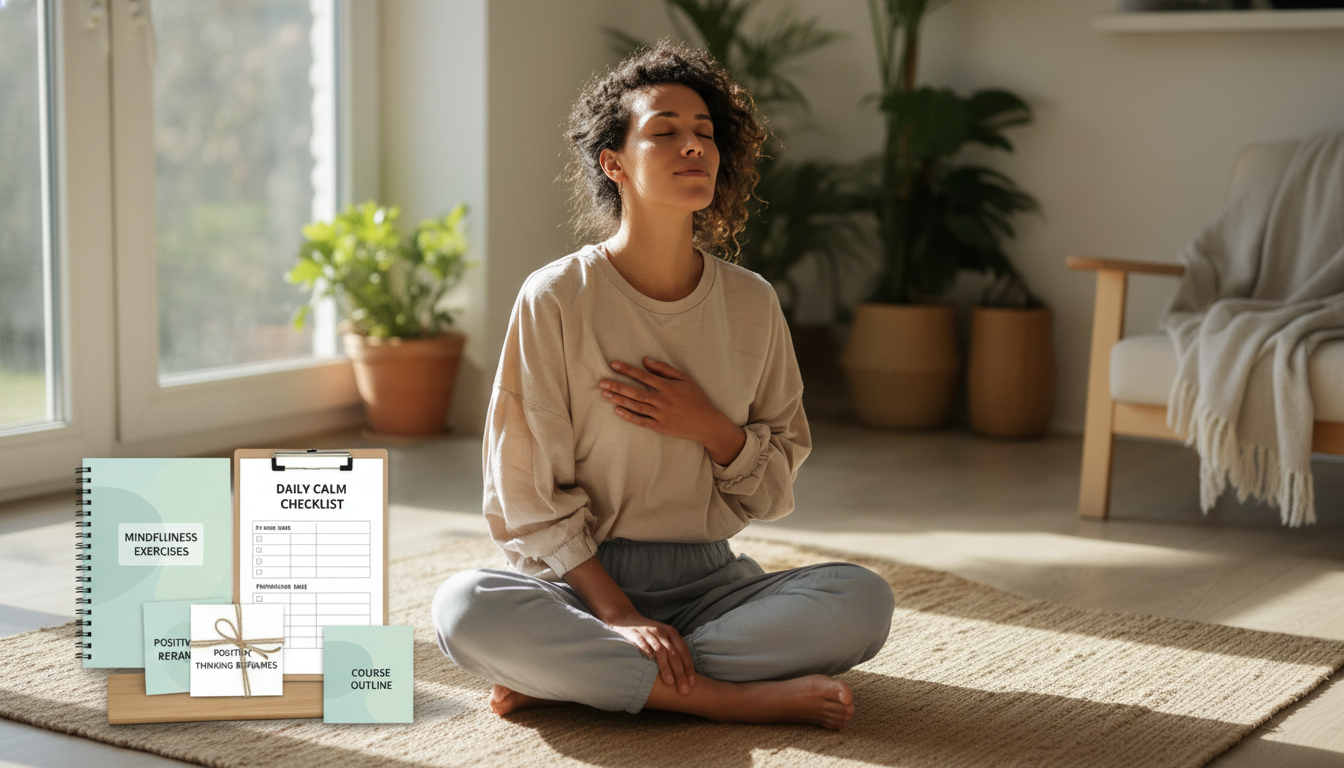
The Anxiety Relief Bundle: A Path to Calm — A 4-in-1 Plan for Mindfulness, Positive Thinking, and Daily Practice
Anxiety often feels unpredictable, but day-to-day relief usually comes from predictable supports: simple practices, clear prompts, and a plan that makes it easier to follow through. This 4-in-1 bundle is designed to turn calming skills into a routine with guided mindfulness exercises, positive thinking tools, a printable checklist for consistency, and a course outline that organizes everything into a step-by-step path.
What the bundle is designed to support
- Reduce overwhelm by breaking coping skills into small, repeatable actions
- Build awareness of anxious patterns without getting stuck in them
- Create a practical routine that is easy to return to on high-stress days
- Encourage healthier self-talk using structured prompts (not forced positivity)
- Provide printable tools that can be used offline for quick reference
- Offer an organized learning path via the course outline so the tools feel connected
If you’d like a single, structured set of resources you can come back to when your mind is spinning, the The Anxiety Relief Bundle: A Path to Calm | 4-in-1 Bundle | Mindfulness Exercises, Positive Thinking, Printable Checklist & Course Outline is built around exactly that: small steps, repeated often, with fewer decisions to make when you’re already stressed.
What’s included in the 4-in-1 bundle
- Mindfulness exercises: short practices to help shift attention from spiraling thoughts to present-moment cues (breath, body sensations, sounds, grounding)
- Positive thinking tools: prompts and reframes that help challenge catastrophic thinking and replace it with balanced, realistic perspectives
- Printable checklist: a simple tracking system for daily or weekly follow-through, especially helpful when motivation is low
- Course outline: a structured sequence that organizes skills into a clear progression (learn → practice → reflect → maintain)
Bundle components and how they’re typically used
| Component | Best used when… | Typical time needed | What it helps build |
|---|---|---|---|
| Mindfulness exercises | Mind is racing; body feels tense; hard to focus | 3–10 minutes | Attention control, calming response, grounding |
| Positive thinking prompts | Anxious predictions feel like facts; self-criticism spikes | 5–15 minutes | Cognitive flexibility, balanced self-talk |
| Printable checklist | Consistency is the main challenge; days feel chaotic | 1–2 minutes | Habits, momentum, accountability |
| Course outline | Not sure where to start or how to progress | Varies by lesson | Structure, confidence, long-term routine |
A simple weekly rhythm using the course outline
Instead of trying to “do everything,” a weekly rhythm keeps the skills connected while staying realistic. Think of it as gentle repetition with one main focus each day.
- Day 1: Baseline check-in — note top triggers, body signals, and one realistic goal for the week
- Days 2–3: Mindfulness focus — practice one short exercise daily and jot down what changes (even small shifts)
- Day 4: Thought reset — choose one recurring anxious thought and run it through a positive-thinking prompt to find a more balanced alternative
- Day 5: Combine skills — mindfulness first, then a reframe while the nervous system is calmer
- Day 6: Review and simplify — identify which tool felt most helpful and which felt hardest to use
- Day 7: Plan the next week — set a minimum routine (the smallest version that still counts) and add it to the checklist
For readers who want to understand anxiety more broadly, reputable overviews can be helpful alongside daily practice, such as the NIMH guide to anxiety disorders and the NHS overview of generalized anxiety disorder.
Mindfulness exercises that pair well with anxious moments
Mindfulness doesn’t need to be long or perfect to be useful. Short, repeatable exercises can reduce the “stuck” feeling by giving your attention something concrete to do.
Mindfulness is also well-supported as a stress-reduction approach; the APA’s overview of mindfulness meditation is a useful reference if you like seeing the research context.
Positive thinking that stays realistic (and actually helps)
Using the printable checklist to build consistency
If your stress is closely tied to household routines (especially during the school year), pairing an anxiety routine with a structure tool can reduce daily friction. Some families use printables like the Homework Help Made Easy Toolkit for Parents – Printable Guide for Creating Study Habits, Homework Strategies & Independent Learning to stabilize evenings, which can make it easier to follow through on your own calming practices too.
Who this bundle fits best (and when to consider extra support)
When you’re ready to put the pieces together into one routine, the Anxiety Relief Bundle offers a straightforward way to practice: a few minutes at a time, guided by prompts, tracked by a checklist, and organized by a clear sequence.
FAQ
How quickly can mindfulness exercises help with anxiety?
Some people notice a small shift in a few minutes (like reduced mental speed or less body tension), especially with grounding or paced breathing. Longer-lasting change typically comes from consistent practice over time, and results vary based on how activated your nervous system feels in the moment.
What if positive thinking feels fake or makes anxiety worse?
It helps to focus on balanced reframing rather than forced positivity—language that is realistic, specific, and grounded in evidence. If “Everything will be fine” spikes anxiety, try coping-based statements like “If this is hard, I can take one step at a time and ask for support.”
How should the printable checklist be used if motivation is low?
Use a minimum routine so you can still succeed on tough days, and track completion rather than how calm you felt. Anchoring the habit to an existing routine and having a simple restart plan after missed days helps consistency build without pressure.










Leave a comment