Critical Thinking eBook: Smarter Decisions + Brain Teasers
Smarter Decisions Start with a Repeatable Method
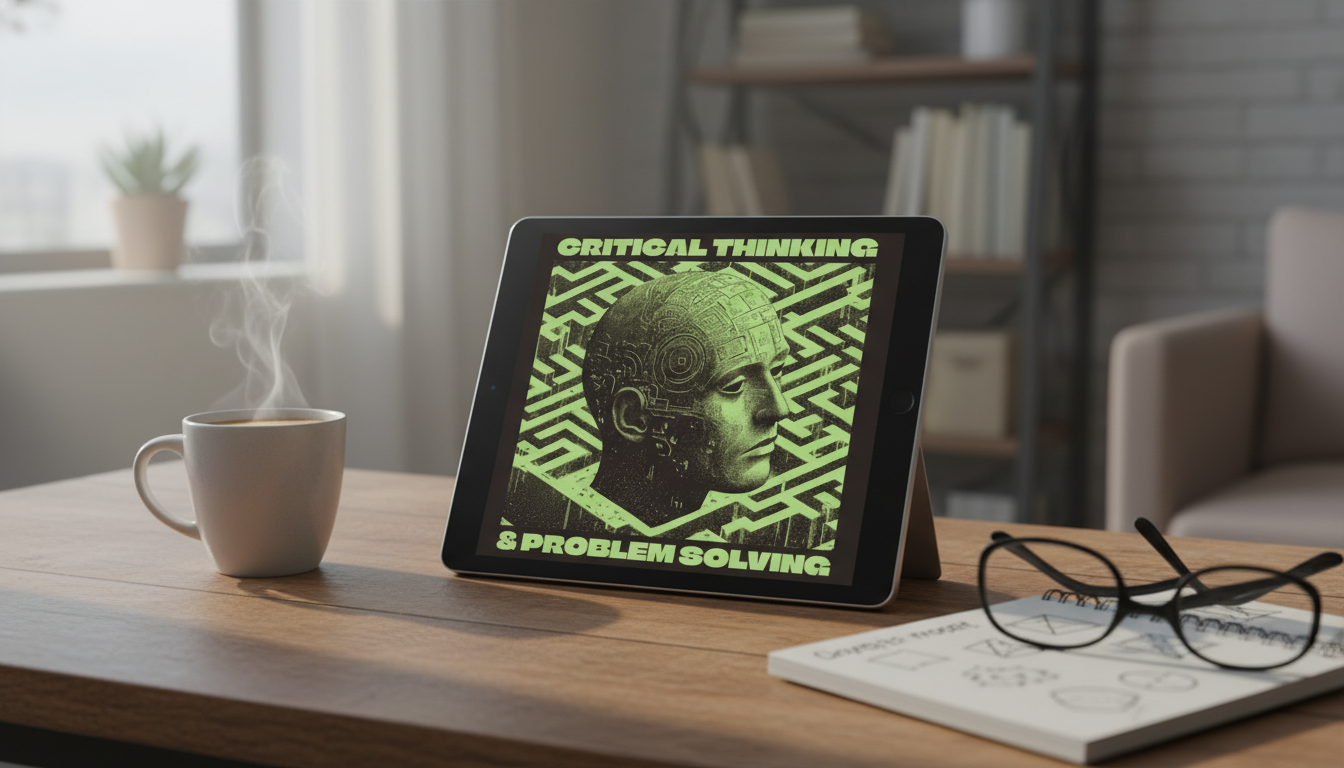
Better decisions rarely come from “thinking harder” alone—they come from using repeatable tools that reduce bias, clarify trade-offs, and stress-test assumptions. The Critical Thinking & Problem Solving eBook – Digital Download Guide for Smarter Decision Making, Brain Teasers & Life Skills Ebook is built around practical routines you can use in everyday life, reinforced with brain teasers and real-world scenarios. The goal is simple: turn messy choices into calmer, more consistent outcomes at work, school, and home—without relying on gut-feel alone.
Critical thinking is often described as disciplined judgment and careful reasoning (see the Stanford Encyclopedia of Philosophy overview), while problem solving focuses on moving from a current state to a desired one through workable steps (as defined in the APA Dictionary of Psychology). This eBook blends both into a practical “do this next” toolkit.
What this eBook helps build
- A structured approach to define problems clearly before jumping to solutions
- Decision habits that separate facts, interpretations, and emotions
- Pattern-spotting through puzzles and brain teasers that strengthen reasoning under uncertainty
- Practical life skills: prioritizing, planning, evaluating options, and communicating conclusions
- Confidence in identifying weak arguments, hidden assumptions, and misleading data
Many daily decisions go sideways for predictable reasons: unclear goals, rushed timelines, and untested assumptions. Building a routine reduces those failure points—especially when you practice the same steps across different situations, from budgeting to project planning.
Who it’s for (and where it fits best)
- Students who want clearer reasoning for assignments, exams, and research tasks
- Professionals who make frequent judgment calls and need a consistent decision framework
- Parents and caregivers teaching problem-solving, logic, and independence
- Puzzle-lovers who want brain teasers tied to real-life reasoning skills
- Anyone aiming to reduce second-guessing by using a repeatable process rather than gut-feel alone
Because it’s a digital download, it fits neatly into a weekly routine: a short “decision drill,” a quick puzzle session, and a simple review note. Consistency matters more than intensity.
A practical decision routine: from messy situation to clear next step
A dependable routine prevents common mistakes like solving the wrong problem, accepting shaky evidence, or choosing between only two options. The eBook’s approach can be summarized as a six-step loop:
- Step 1 — Define the decision: write a one-sentence “choice statement” (what must be decided, by when)
- Step 2 — Separate signals from noise: list known facts, unknowns, and assumptions; mark what needs verification
- Step 3 — Generate options: include at least one “do nothing / delay” option to avoid false urgency
- Step 4 — Compare trade-offs: use simple criteria (cost, time, risk, impact, reversibility)
- Step 5 — Stress-test: ask what would change the decision; identify failure modes and early warning signs
- Step 6 — Decide and review: set a checkpoint to learn from results and adjust future choices
Quick checklist for smarter everyday decisions
| Checkpoint | Prompt to ask | What it prevents |
|---|---|---|
| Clarity | What is the actual question? | Solving the wrong problem |
| Evidence | What is known vs assumed? | Overconfidence and rumors |
| Options | What else could be done? | Binary thinking |
| Trade-offs | What is being sacrificed? | Hidden costs |
| Risk | What could go wrong first? | Surprises and avoidable losses |
| Learning | When will this be reviewed? | Repeating the same mistakes |
Brain teasers that strengthen real-world reasoning
Brain teasers aren’t just entertainment when they’re paired with reflection. The eBook uses puzzles as “micro-simulations” for real decisions, training you to slow down, test constraints, and notice what you’re assuming.
- Logic and constraint puzzles improve “working backward” and checking for contradictions
- Probability and pattern challenges sharpen intuition around uncertainty and base rates
- Lateral-thinking prompts train flexibility—finding alternatives when the obvious path stalls
- Short, timed puzzles build focus and reduce mental drift during complex tasks
- Reflection prompts connect puzzle techniques to daily decisions (shopping, scheduling, work priorities, conflict resolution)
That last bullet is where the value compounds: after solving a teaser, you immediately apply the same technique to a real choice—like creating better options, testing a claim, or identifying the single assumption your plan depends on.
Common thinking traps—and how the guide helps counter them
Bias isn’t only about “bad thinking”; it’s often a shortcut that worked in the past but fails in modern, information-heavy situations. Resources like the NIST/SEMATECH e-Handbook of Statistical Methods discuss bias concepts in ways that highlight how easily judgment can drift.
Digital download details and how to get the most from it
If you want a ready-to-use starting point, the Critical Thinking & Problem Solving eBook (Digital Download) is designed to be opened, practiced, and reused—rather than read once and shelved.
Related resource for study structure and independent learning
Clear thinking gets even easier when daily routines are stable. For learners who want stronger habits alongside better reasoning, the Homework Help Made Easy Toolkit for Parents – Printable Guide for Creating Study Habits, Homework Strategies & Independent Learning supports structure, planning, and follow-through. Combining study routines with a decision framework can reduce last-minute pressure and make outcomes more predictable.
FAQ
Is this eBook suitable for beginners who feel “not naturally logical”?
Yes. The material emphasizes repeatable steps, approachable examples, and progressive practice, so “being logical” becomes a skill you build rather than a trait you either have or don’t.
How long does it take to see improvement in decision making?
Many people notice better clarity within days (because the questions are structured), while consistency typically improves over a few weeks with a simple weekly routine and a basic decision journal.
Does puzzle practice actually transfer to real-life problem solving?
It transfers best when each puzzle is followed by a reflection step and a real-world application using the same method—so the reasoning pattern becomes something you can repeat outside the puzzle context.










Leave a comment